The situation
Open-source products face a specific design governance challenge: contributors ship code continuously, often without a designer in the loop. For most features this is fine — but for an AI product where memory surfacing and message routing directly shape user trust, inconsistent design decisions compound fast. An AI that presents its memory system differently across three screens is not just visually inconsistent; it erodes the confidence users need to rely on it.
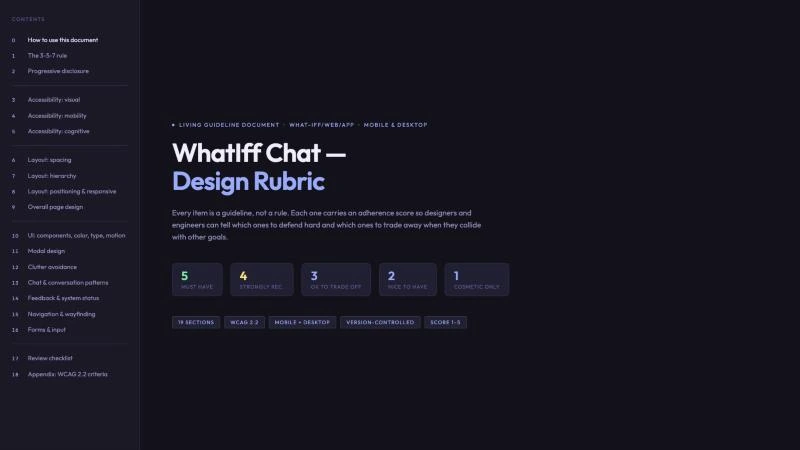
The WhatIff design rubric was written to solve this without creating a design bottleneck. The goal was a reference that engineers could consult to make confident design decisions independently — not a strict spec that required designer sign-off on every change.
The rubric
19 sections with a 1–5 adherence scoring system — engineers can trade off any guideline against deadlines without needing a designer in the loop, as long as the trade is recorded. Every item states the rule, the score, the platform it applies to, and a standard reference (WCAG, Nielsen, platform HIG) so decisions are grounded, not subjective.
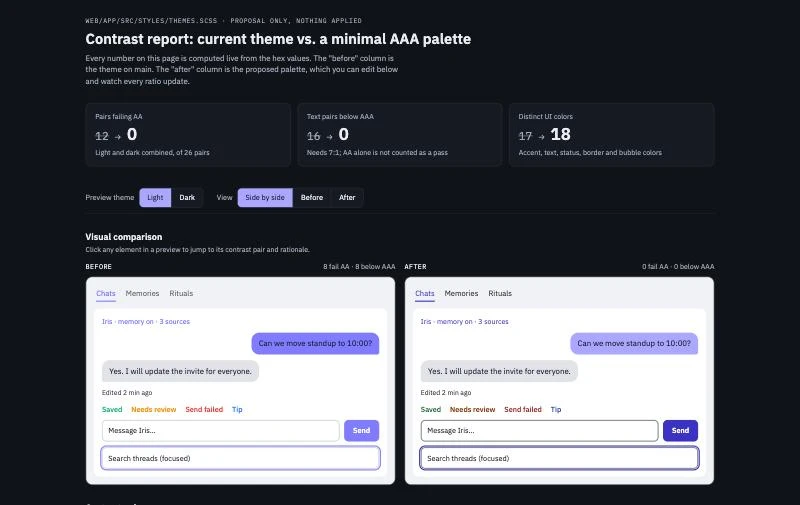
The contrast audit is a companion artifact — a live HTML tool that computes AA/AAA ratios against every color pair in the app's theme token set. The "before" column is the original theme pulled from themes.scss; the "after" column is the proposed palette. 12 failing pairs resolved to 0 without changing brand identity.
Both artifacts are version-controlled with the codebase. When a component changes, the review checklist in section 17 is the first thing an engineer opens — not a Jira ticket or a Slack message to design.