The situation
L'Oreal USA needed a way to be proactive about engaging employees, building a culture where employees wanted to stay within the company. Leadership wanted to understand why employees were leaving — or who was likely to leave next. HR leadership knew this was costing the company in talent, institutional knowledge, and ongoing backfill recruiting expense, but lacked the analytical infrastructure to act on it. There was no predictive model. 2016 was a year when machine learning was starting to gain organizational awareness, and this was an opportunity to showcase what it could be used for.
As a volunteer member of the People Innovation team — alongside my Director of HRIS responsibilities — I saw an opportunity to prove what was possible. The project started not with a budget or a mandate, but with a hypothesis and a willingness to build something from scratch, and partner with leaders who shared the same vision.
Solving the problem
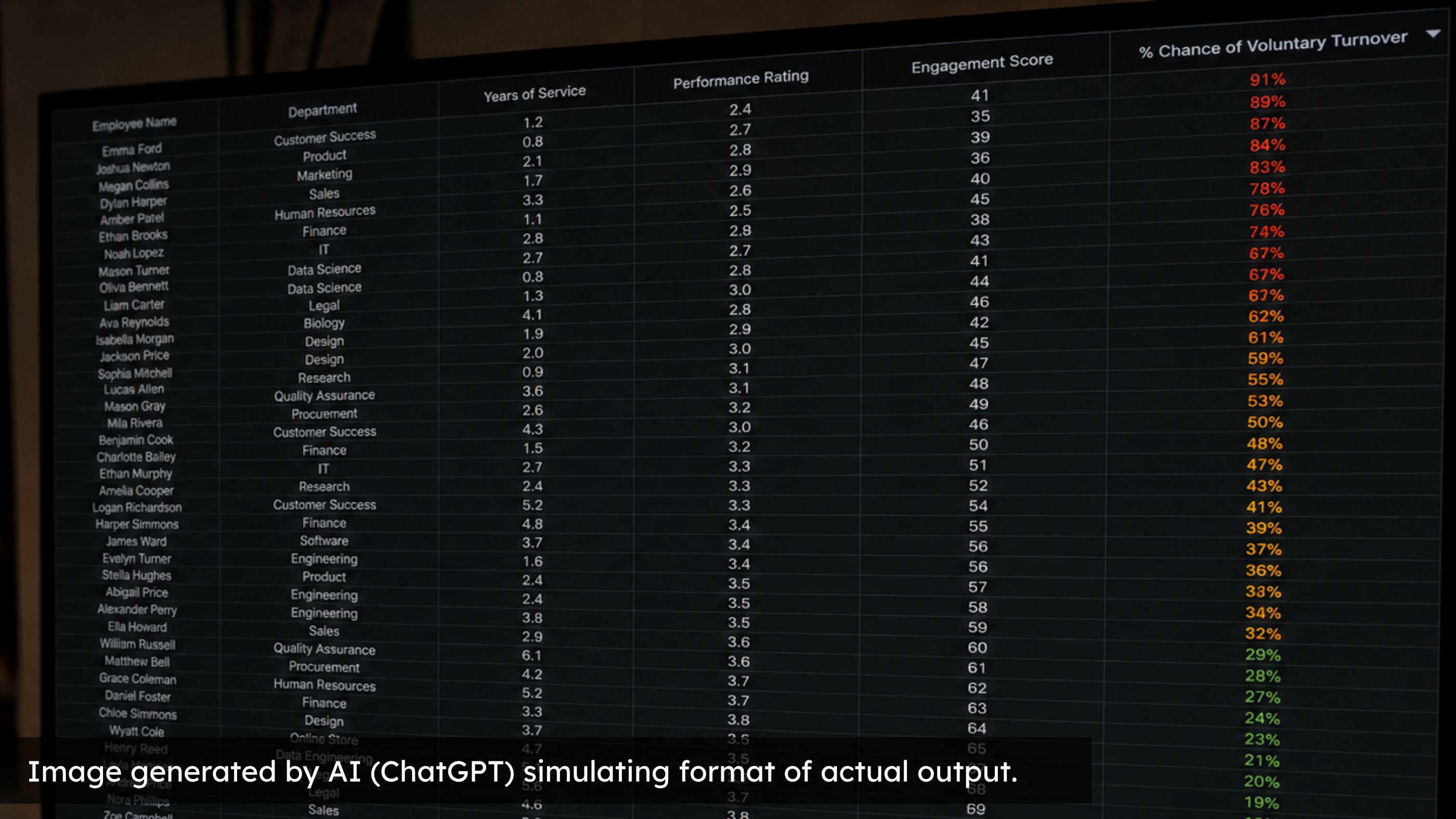
Building the model required stitching together years of HR data — performance records, compensation history, tenure patterns, promotion history, recruitment patterns — into a training dataset clean enough to generate reliable signal. The team took the opportunity to partner with Stevens Institute of Technology, Wharton, and a data analytics company, Spotfire. 3 groups, 3 insights, and multiple opportunities to learn what might work and what might be blind spots. The result was an attrition prediction model that reached 82% accuracy — and a story compelling enough to take to the C-suite.
- Solved the same problem three ways — deliberately. Partnering with Stevens Institute of Technology, Wharton, and Spotfire was a highly strategic decision, not a redundancy. Each group independently approached the same attrition problem using their own methods and techniques. The value was acceleration: comparing three solutions at once surfaced what actually worked, exposed decision bias and blind spots that any single approach would have missed, and identified success patterns grounded in real-world practice. Triangulating across three independent sources built confidence in the model that no single vendor or academic partner could have provided alone.
- Built and validated the attrition model end-to-end. Worked across HR and data teams to engineer features, define the model architecture, and validate performance against historical outcomes — landing at 82% accuracy using 12 years of workforce data. The model identified at-risk employees with enough lead time for managers to intervene.
- Translated model outputs into a C-suite narrative. Raw accuracy metrics don't move executives. The findings were reframed as a strategic business case connecting predicted attrition to cost-per-hire, productivity loss, and division-level exposure — and presented directly to L'Oreal USA's executive leadership team, creating buy-in for what came next.
- Piloted with one Division to generate real-world proof. Rather than proposing an organization-wide rollout, the model was deliberately scoped to a single division first. That proof-of-concept generated actionable results HR could use immediately, while building the credibility that ultimately triggered the creation of a dedicated People Analytics function — for the US, and then globally.